
image note 02/Making light
About Marta Luniv's glimmers, the social life of small illuminations and what we carry for each other in the dark.

Hi.
There is a particular quality of light that people bring to places. Not the functional kind. The kind that is fleeting but leaves an impression. Because of it, you see where you are.
Let’s begin.
Marta Luniv. Glimmers of joy. 2026.
The first frame shows a park in winter. Low needle trees building a roof. The ground is green and brown, walked on too many times. At the centre of the frame: a chair. Luniv enters the frame, walks up to the chair and sits down. As she sits down, string lights, strung from and between the trees, turn on. Warm and amber. She stands up and leaves the frame. The lights stay on.
The project began with a blackout. As experience. The power goes out, as it does, as it keeps doing, and all the electronics stop at once. But the small string lights, connected to a power bank, kept glowing. A tiny act of resistance.
In the second frame, a street at dusk. Residential buildings and a crossroad. The asphalt is wet and reflects the headlights of cars waiting at the light and driving by. Luniv crosses the street. In her Hand, she’s holding a sparkler. It’s small but noticeable. It burns white and hot, too bright for the surrounding greyness. A stranger handed it to her. He decided it was her birthday. She took the burning thing and walked. It isn’t her birthday.
And in the third, a wall in a yard. Every surface is covered in snow. Luniv enters the frame, carrying a candle. It’s enormous, proportionate to the public space, disproportionate to be purely functional. She puts the candle on the edge of the wall and lights a match. It takes her some time to light the candle. She steps back. Steps further back. Walks out of the frame. The candle burns on.
The candle was a gift from close friends. To keep her warm all winter, and maybe longer. A glimmer. The pathological term describes a small activation of the nervous system’s sense of safety. Luniv uses it to give a name to the small illuminations she had felt were needed.
The triptych moves from self-sufficiency toward interdependence and shows all simultaneously. It applies domesticity to scales of public space, to make places feel intimate again: This park is still mine. This street is still ours. Especially now.
About the artists:
Marta Luniv (b. 1997, Ivano-Frankivsk, Ukraine) is a multidisciplinary artist based in Kyiv. She received her MA from National University Kyiv-Mohyla Academy in cultural studies and works with photography and artist books. Her practice explores everyday sensory experience and the influence of urban environment on attention. Recent exhibitions include Collision (Ukrainian-Danish Youth House, Kyiv, 2025) and MYPH in the Warehouse (Sklad 5 Art Gallery, Cherkasy, 2025).
Constellation
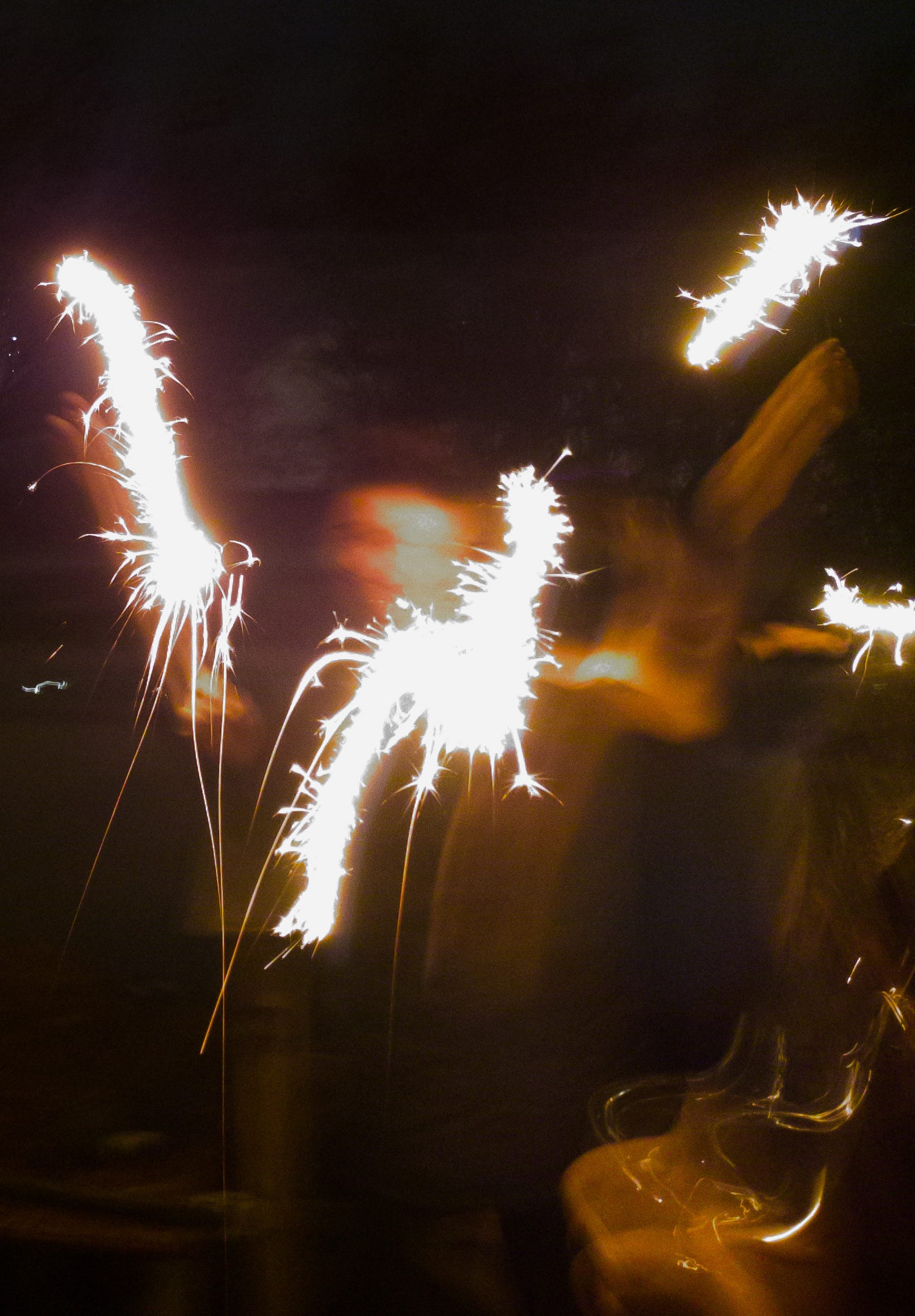
The sparkler burns out in forty seconds. What remains is the afterimage. When you look at something very bright and then look away, the light lingers as the eye’s response to having seen it. The stranger handed Luniv something that burns out quickly. He decided it was her birthday. He made a choice about who she was. The gesture remains. But what do you do with it?
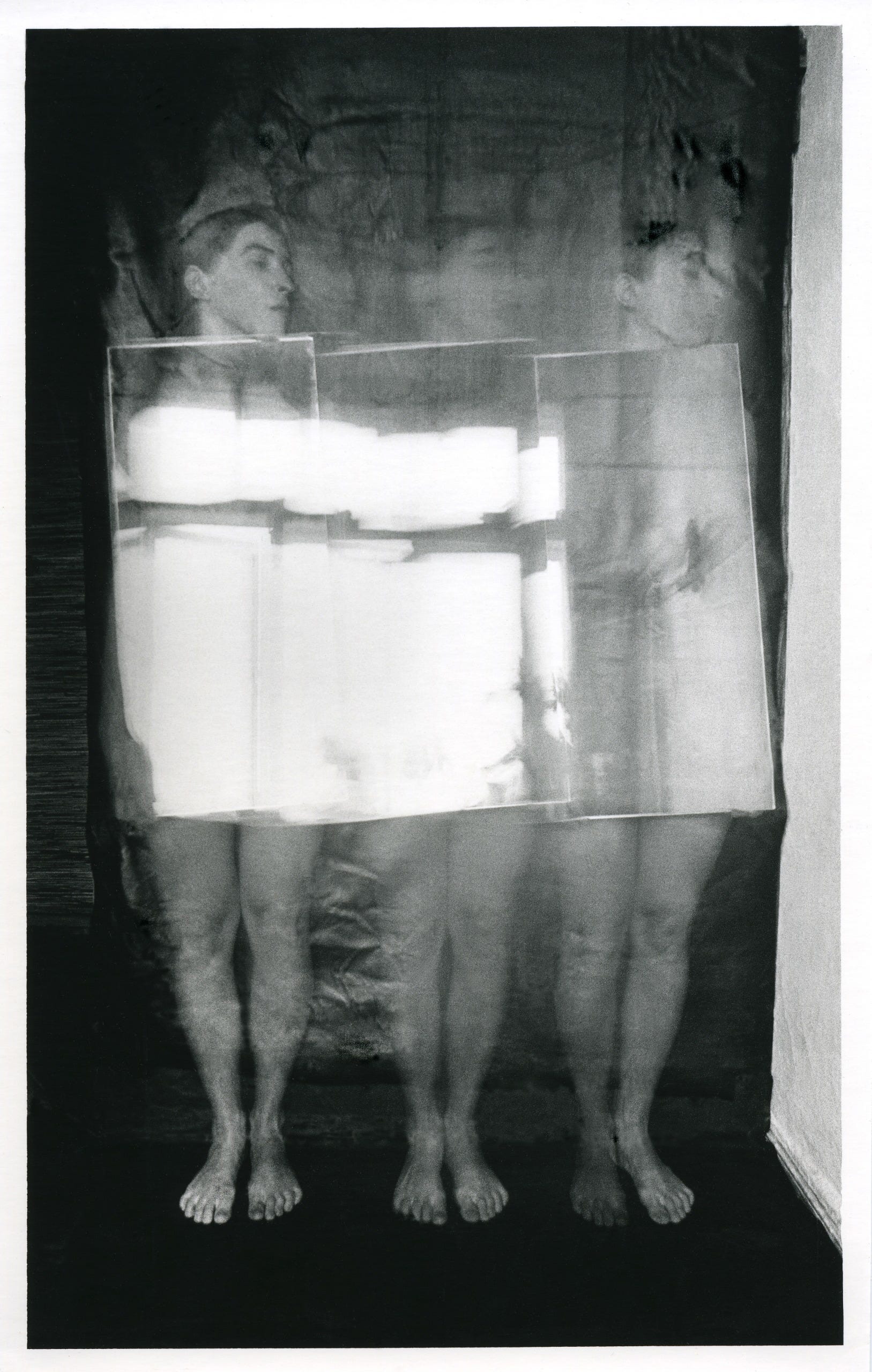
Violeta Bubelytė’s Nude 30 is from a long series of self-portraits the Lithuanian artist has been making continuously since 1981. In this image she appears in multiple exposures, three positions of the same body held in one frame.
Then the light. A mirror covers her body. The mirror reflects something very bright. It’s overexposed. But the outlines of a window and the corner of a room are visible, across the multiplied surface of the mirror being carried from one position to the next. The photograph shows Bubelytė catching the light, redirecting it, moving, again. She is constructing where she is. Directing the reflection, showing us the place she is in.
Looking at the video triptych again and again, I kept being drawn toward another account of what light does in relation to where a person stands in the world. In Camus’s The Stranger, light glares. (I know it's ridiculous to take a novel this complex and strip it to a quality of light. But that is what I'm doing here.)
The light bounces off pavement, off shoulders, off the Arab’s knife on the beach. It shimmers from the landscape at Madame Meursault’s funeral, bleaches the sand flat. Meursault receives all of it as matter of fact and affectless. The glare isn’t a failure of perception. From his balcony, he watches the street lamps come on and sees them illuminate a girl’s hair, a smile, a silver bangle. He stays for hours. The light touches the street, and he goes inside for dinner. It occurs. Then the darkness comes. In his cell, the light is reduced to a patch of sky through a small window. He learns its hours and the particular colour before dark. The world continues without him, and he finds comfort in it.
What he doesn’t do is arrange the light himself. He doesn’t string anything between trees and he doesn’t carry light. The world already offers more surface than he can take in.
Coda
Luniv says “So even though I’m capable of making my own independent list of glimmers, how poor it would be without the people around me.”
The triptych traces a decision. In the first frame she makes the light herself. She carries the domestic into public space and claims it back. That is sovereignty: I am here, in my place. But then she opens. A stranger decides it is her birthday and hands her something burning, and she takes it. Friends give a candle calibrated for duration, for a winter that may be longer than anyone wants to say. She receives the light others made. She carries it.
One of russia’s strategies in this war has been to destroy civilian infrastructure. Substations, heating plants, the grid that keeps the lights on. To take light away and make place unliveable.
And yet, the triptych insists it is not enough to make your own light. In sustained crisis, the question of what you do with the light is not incidental but constitutive. Whether you let it pass through like glare, or whether you carry it outside, redirect it, reflect something back.
Recommended: Blackout Tape by 20ft Records (2025). Kyiv-based radio station 20ft Radio asked Ukrainian musicians to recreate their practice under blackout conditions. The essay on Easterndaze by Olena Pohonchenkova is worth reading alongside it.
That’s it for now.
Lina